Why Smart Parking IoT Solutions Start Underground

Smarter More Sustainable Cities start with IoT sensors underground
Smart parking IoT solutions are becoming essential to smart city strategy, yet most conversations about smart cities still focus on what we can see. Smart lighting, smart kerbs, smart streets and smart buildings dominate conference stages and policy documents. These visible IoT layers shape how urban innovation is imagined and funded.
However, cities do not operate at or above street level alone. The next phase of smart cities will depend on something less visible.
Connected underground infrastructure.
Our cities function through a complex network of underground spaces that quietly enable daily life, from basements and car parks to service corridors, utilities and transport interchanges
If cities are to become more liveable, sustainable and efficient, this hidden layer needs to be integrated into smart city frameworks through reliable smart parking IoT solutions and resilient underground connectivity
Transport Mobility is where Smart Cities become Personal
Transport mobility is one of the most human applications of IoT in cities. It influences commute times, stress levels, accessibility and the overall perception of urban experience.
When mobility systems work well, cities feel intuitive and calm.
When they fail, inefficiencies ripple outward across streets and precincts.
IoT technologies promise real-time visibility and dynamic coordination across transport networks. However, that promise frequently breaks down in the places where many mobility decisions actually occur — underground car parks and basement parking structures.
This is where smart parking solutions play a critical role.
Smart parking IoT solutions use sensors, real-time connectivity and management software to monitor, allocate and optimise parking bays - particularly in underground environments where traditional visibility is limited. They are a foundational layer of modern smart city infrastructure.

Parking Congestion is an Environmental Issue Hiding in Plain Sight
Parking is rarely framed as an environmental problem, yet it contributes significantly to urban congestion and emissions.
Urban planning research, including the seminal work of Donald Shoup, suggests that up to 30% of city traffic can be attributed to drivers searching for parking spaces. This inefficiency becomes amplified in parking in basements, where vehicles circulate repeatedly at low speeds, engines idle, and carbon emissions accumulate without meaningful movement.
In many commercial buildings, parking capacity already exists. The challenge is not a lack of physical space. It is a lack of digital visibility.
When drivers cannot see available parking spots, they continue circulating. When access rules are unclear, visitor parking,disability bays, EV charging bays,dedicated tenant and staff parking, and hospital parking bays are misused.
In underground environments where connectivity is limited, static systems allow inefficiencies to compound.
This is where smart parking IoT solutions can reduce congestion by improving allocation, visibility and real-time control.
The Underground Paradox: Infrastructure without Connectivity
Cities have invested billions into underground infrastructure over decades.
Car parks, tunnels, utilities and service corridors represent enormous sunk cost and operational importance, particularly across commercial parking assets and major transport hubs such as airport parking facilities.
Yet many of these environments remain digitally disconnected.
Concrete, steel and structural depth degrade GPS signals, weaken cellular coverage and limit Wi-Fi reliability. As a result, traditional smart city deployments often assume network conditions that do not exist underground.
Sensors are straightforward to deploy in open-air environments.
They are far more complex to deploy reliably in dense, signal-hostile basements.
This creates a paradox: some of the most valuable urban infrastructure remains digitally invisible.
Why Underground IoT requires a Different Design Mindset
Underground connectivity is not simply a hardware challenge. It is a systems design problem.
Solutions designed for above-ground environments rarely translate into dense underground conditions where reliability, low latency and energy efficiency matter most.
Designing resilient smart parking IoT solutions for basements requires:
Low-power devices capable of long-term operation
Intelligent gateway placement
Signal-tolerant communications architecture
Seamless integration with building infrastructure
When designed correctly, smart parking infrastructure becomes an enabling layer for broader smart mobility ecosystems.
Parking as an Entry Point, not the Destination
Parking is one of the most universally understood urban systems. Every building has it. Every driver experiences it.
That familiarity often disguises its complexity.
Parking sits at the intersection of mobility, behaviour, infrastructure and data. It reveals inefficiencies quickly when systems are poorly connected.
When parking operates effectively, upstream congestion decreases and downstream traffic flow improves. When it fails, congestion spreads into surrounding streets.
This is why smart parking IoT solutions are emerging as foundational components of modern smart city architecture.
Designing Smart Parking from the Basement Up
A new phase of smart city thinking is emerging. Rather than layering technology on top of visible infrastructure, forward-looking urban strategy is beginning to unlock the value of existing underground assets.
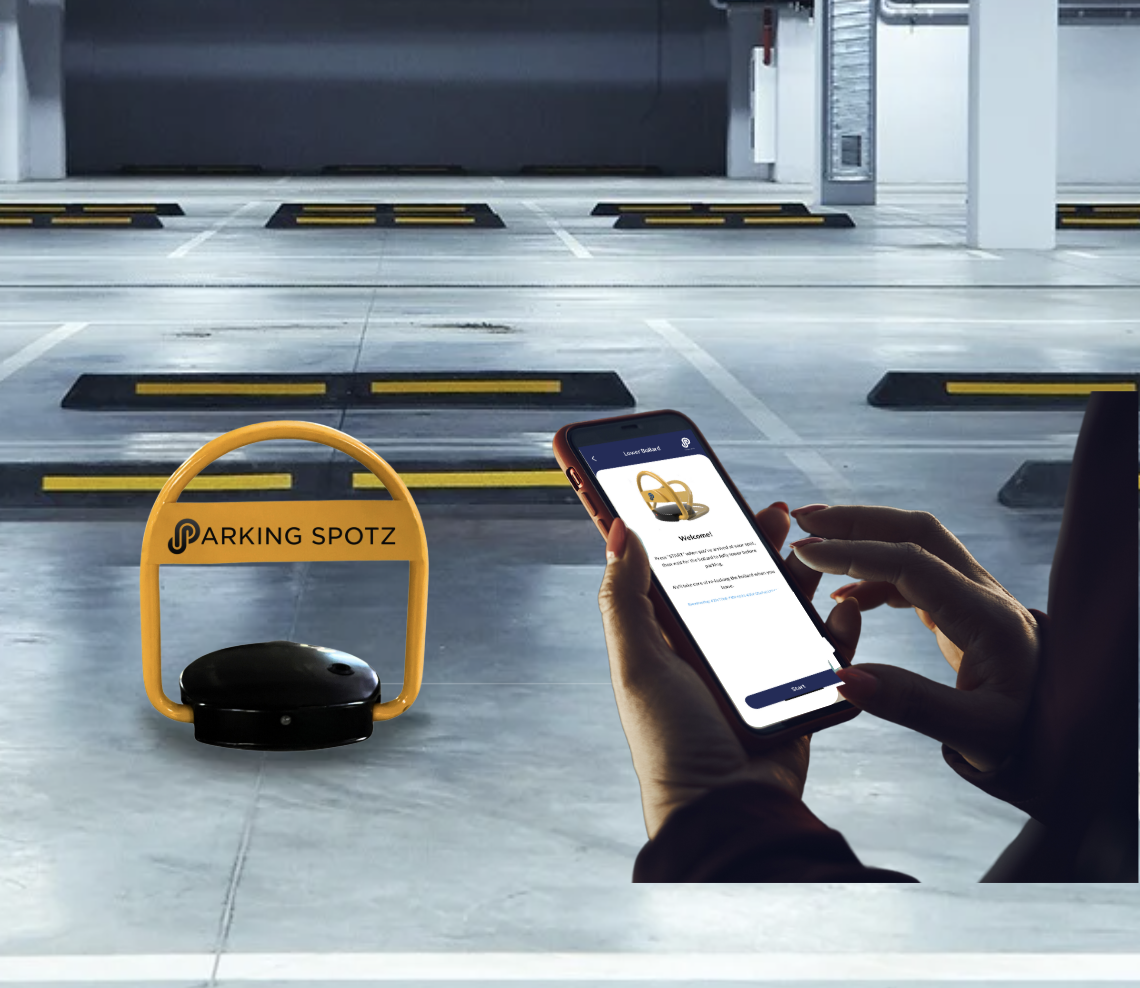
This approach transforms static underground car parks into dynamic, connected systems capable of:
Real-time allocation
Demand-responsive management
Protected visitor and priority access
Optimised EV charging coordination
Within this context, smart parking solutions highlight that underground connectivity is not optional. It is foundational.
A Practical Expression of Underground IoT
At Parking Spotz, this philosophy shaped our engineering direction from the outset.
Building on the hardware foundation developed through thatsMYspot, we focused on solving connectivity in challenging underground environments.
Rather than treating parking as a static asset, we reconfigured it as a connected mobility system.
The objective was not simply to manage parking spots more efficiently. It was to demonstrate how underground IoT infrastructure can unlock better transport outcomes across commercial buildings, mixed-use precincts and airport environments.
Parking is our entry point.
Our applications extend far beyond it.
That approach is already delivering results. Our case studies for application in both residential visitor parking and commercial parking location results
From Parking Systems to Connected Underground Ecosystems
Once reliable underground connectivity exists, multiple systems improve simultaneously.
EV charging access becomes fairer and more manageable.
Accessible and priority bays are protected.
Shared fleets operate efficiently.
Facility managers gain real-time utilisation insights.
Most importantly, unnecessary vehicle circulation decreases.
Less circling.
Less idling.
Lower emissions.
Smarter underground systems reduce environmental impact not by forcing behavioural change, but by removing inefficiency from the system itself.

Rethinking What Makes a City Smart
Smart cities are often defined by what they add — sensors, platforms, dashboards.
The next evolution of smart cities will be defined by what they unlock.
Existing infrastructure.
Latent capacity.
Digitally invisible underground assets.
If cities are serious about transport mobility, emissions reduction and long-term sustainability, the conversation must expand below street level.
Smart cities will not be built solely above ground.
They will be unlocked by connecting the spaces beneath it.
If you are exploring how to unlock value in your underground car parks through smart parking IoT solutions, we would welcome the conversation.
Parking Spotz specialises in smart parking IoT solutions for underground car parks across commercial buildings, mixed-use precincts and major transport hubs. If you are ready to unlock the latent value in your underground infrastructure, contact us to start the conversation.
Frequently Asked Questions
What are smart parking IoT solutions?
Smart parking IoT solutions are sensor-based systems that connect parking bays, access controls and management software in real time. They allow facility managers and building operators to monitor occupancy, enforce bay allocations, manage EV charging access and generate utilisation data — all from a central platform. In underground environments, they solve the specific challenge of operating reliably without GPS or strong cellular coverage.
Why is underground IoT connectivity so difficult?
Concrete, steel reinforcement and structural depth all attenuate radio signals, which means GPS is unavailable and Wi-Fi and cellular coverage are unreliable or absent in most basement car parks. Standard smart city IoT hardware is designed for open-air or above-ground environments and frequently fails in these conditions. Effective underground IoT requires low-power devices, intelligent gateway placement and a communications architecture specifically engineered for signal-hostile environments.
How does smart parking reduce carbon emissions?
A significant share of urban vehicle emissions comes not from driving between destinations, but from circling in search of a parking space. Research by urban planning economist Donald Shoup suggests up to 30% of city traffic at any given time consists of drivers searching for parking. When smart parking systems provide real-time bay availability and enforce correct allocation, unnecessary circulation is eliminated — reducing idle emissions without requiring any behavioural change from drivers.
What types of buildings benefit most from smart parking IoT?
Commercial office buildings, mixed-use precincts, hospitals, retail centres and airport facilities all benefit significantly, particularly where parking is shared between tenants, visitors and staff with competing access needs. Strata and residential buildings with basement car parks also gain from automated bay protection and EV charging management. Essentially, any building with an underground car park that operates multiple bay categories — reserved, visitor, disability, EV — is a strong candidate.
Is smart parking part of a smart city strategy?
Yes — and increasingly, it is recognised as a foundational component rather than an optional add-on. Smart parking sits at the intersection of transport mobility, emissions reduction and building data infrastructure. Because parking is the first and last interaction most people have with a building or precinct, it directly shapes urban experience. Connecting underground car parks to smart city platforms extends IoT coverage into the built environment’s most data-poor layer.
How does Parking Spotz approach underground IoT differently?
Parking Spotz was engineered from the ground up for underground environments, building on the hardware foundation of That’s My Spot’s smart bollard technology. Rather than adapting above-ground IoT systems for basement conditions, the platform was designed specifically to operate reliably in dense, signal-hostile car parks. The result is a connected parking management system that treats underground infrastructure not as a constraint, but as the starting point for broader smart mobility outcomes.
About the Author
Angelique Mentis is the founder and CEO of Parking Spotz, an Australian underground infrastructure technology company, and the founder of That’s My Spot, a smart parking bollard business. She also served as director and President of Parking Australia, the peak industry body for parking in Australia.
With deep expertise in IoT connectivity, smart city infrastructure and commercial parking operations, Angelique leads both businesses from Sydney, working with property managers, facility managers and urban developers across Australia to unlock the value of connected underground assets.