
Your GRESB submission is missing 70% of your building - and How to Fix It.
Why Parking Basements are the missing link to your GRESB score
Underground parking infrastructure is one of the most measurable, most addressable, and most consistently overlooked opportunities to improve GRESB performance. Here is exactly why — and what we can do about it.
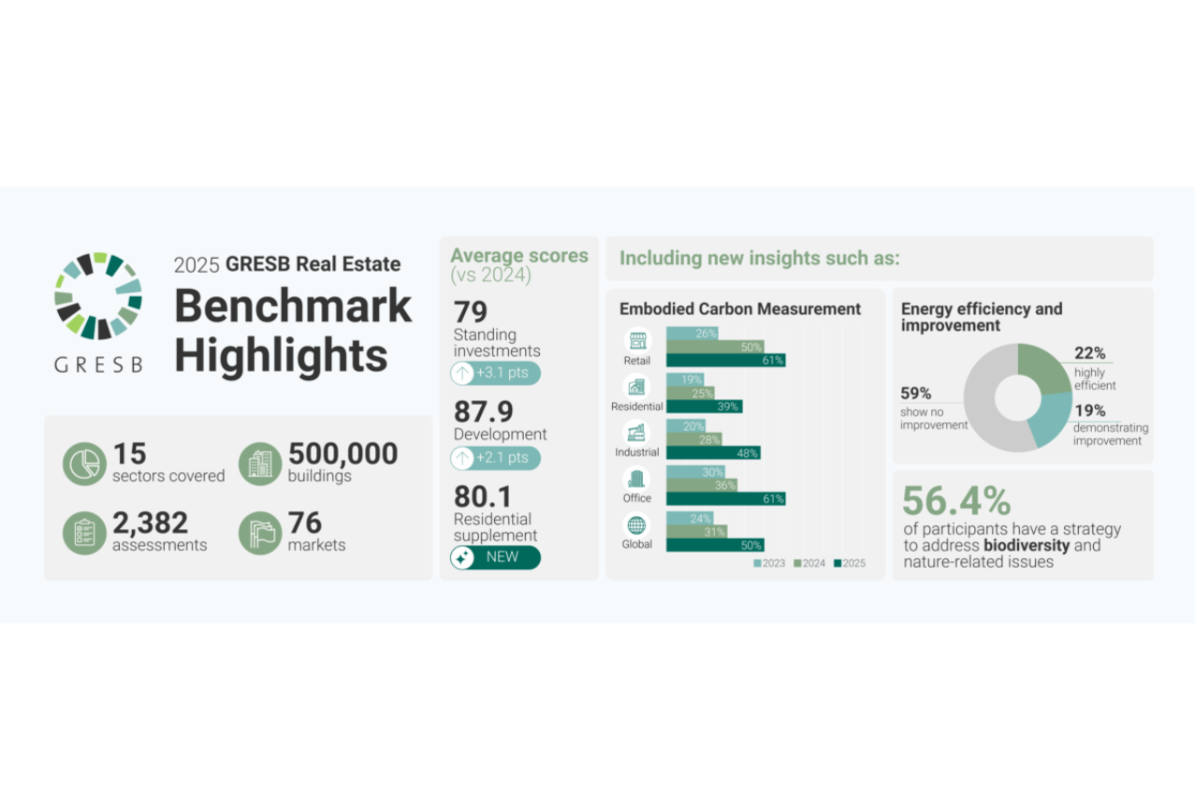
GRESB benchmarking has moved from nice-to-have to board-level imperative. Institutional investors use it. Sovereign wealth funds rank portfolios by it. And with 2,382 real estate assessments submitted in 2025 — including 239 entities participating in the inaugural Residential Component — the benchmark now covers an enormous share of the global institutional real estate market.
The urgency behind all of it is real. According to the UNEP Global Status Report for Buildings and Construction 2025–2026, just released this month, buildings operational emissions rose to 9.9 gigatons of CO₂ in 2024 — up 1% on the prior year and 6.5% above 2015 levels. The sector consumes 32% of global energy and generates 34% of global CO₂. The net zero pathway requires deep, measurable cuts. Every asset counts.
Yet in almost every GRESB conversation I have with facilities managers and asset owners, one significant performance gap goes unaddressed.
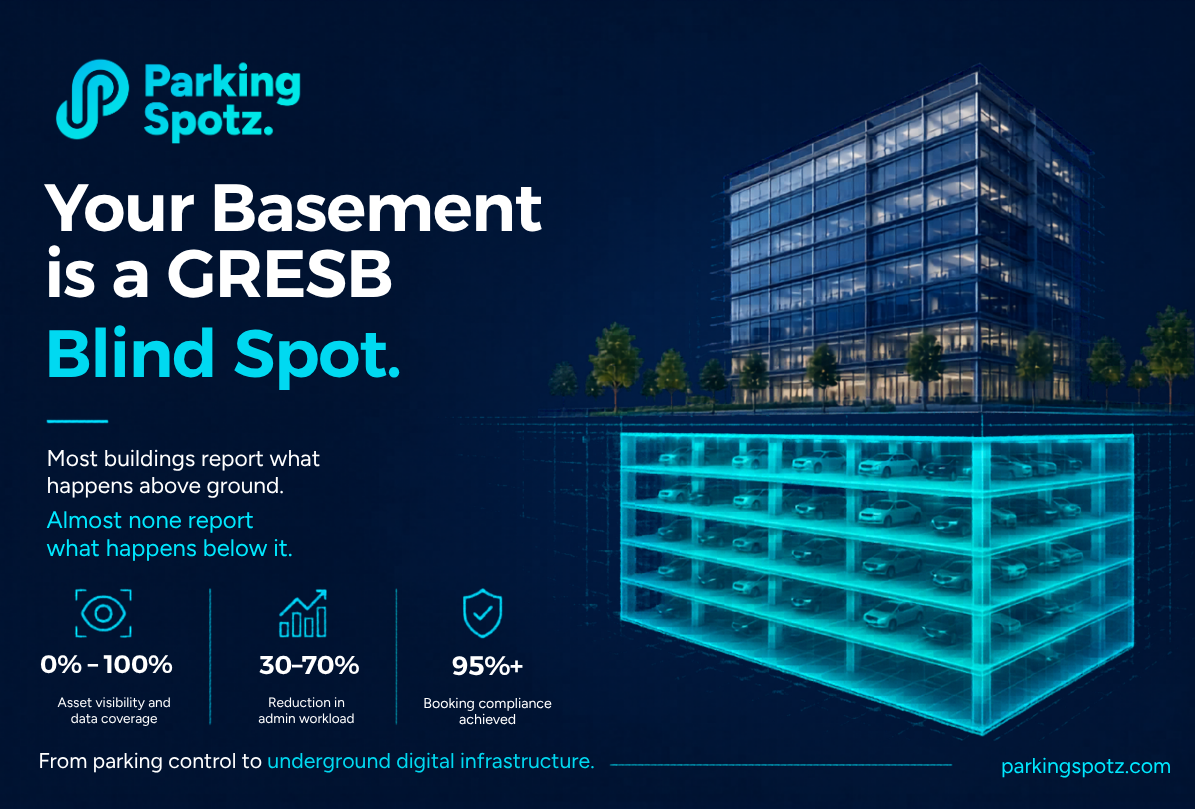
T H E B A S E M E N T.
GRESB 2025 Benchmark Highlights
What the 2025 GRESB Results Tell Us
The 2025 GRESB Real Estate Assessment results show meaningful movement on net zero. Net zero policies are now in place at 81.5% of participants — up from 78.8% in 2024 and 72.4% in 2023. Targets reached 66.4%, a 16-point jump in two years. GRESB's own analysis notes a clear shift from ambition to implementation: more participants are moving from commitment to evidence.
That shift matters for how your submission is assessed. The 2026 GRESB Standard updates — in effect for the current reporting cycle — are the most consequential in years. Embodied carbon is now scored for the first time, net zero targets face stricter credibility requirements, and GHG scope reclassification changes how landlord-controlled tenant spaces are reported. Every unmonitored asset in your portfolio is a direct liability in this environment.
2025 GRESB Real Estate Benchmark Highlights
7 Ways Smart Parking Moves Your GRESB Score
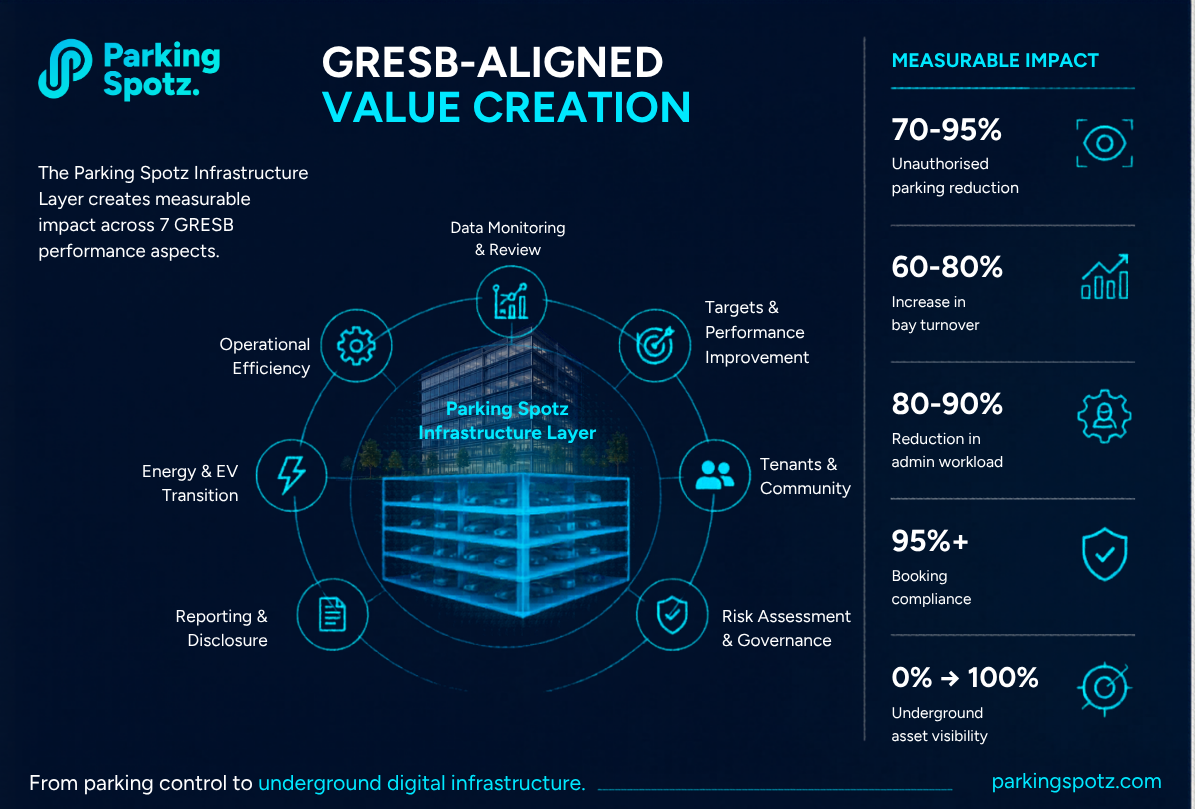
Underground parking infrastructure is relevant to seven GRESB scored aspects. Most portfolios score zero across all of them from their basement assets. Here is how Parking Spotz changes that.
1. Data Monitoring & Review
GRESB rewards data coverage. The 2026 Standard requires participants to report coverage estimates for key KPIs — unmonitored assets are an active drag on your score. Parking Spotz delivers real-time bay occupancy, utilisation trends, and compliance rates from day one of deployment. We move your basement from data black hole to full digital coverage.
2. Targets & Net Zero Evidence
With 66.4% of GRESB participants now holding net zero targets and the 2026 GRESB Standard tightening credibility requirements for those claims, aspirational commitments without asset-level evidence are exposed. Parking Spotz creates the verifiable data trail that GRESB's net zero documentation requirements demand — for assets most buildings currently cannot evidence at all.
3. Tenant & Community Experience
Tenant satisfaction is a scored aspect. Parking is one of the most consistent sources of tenant complaints in commercial buildings. We consistently see 80-90% reductions in parking-related complaints after deployment. Measurable, reportable, GRESB-ready.
4. Risk Assessment & Governance
Without digital access controls or audit logs, underground car parks create liability exposure and compliance risk. Parking Spotz provides permissions management, enforcement records, and accountability reporting — structured governance for an asset class that has historically operated without it.
5. Reporting & Disclosure
The 2026 Standard places increased weight on outcome-based, asset-level data. Major consultancies including CBRE and JLL identify operational data gaps — including parking — as an emerging ESG focus for institutional portfolios. Parking Spotz creates a reporting layer for these assets where none previously existed.
6. Energy Performance & EV Transition
With buildings responsible for 9.9 Gt of CO₂ in 2024 according to UNEP’s latest data, every sub-metering improvement is material. Parking Spotz generates real-time EV charging demand data from the basement, enabling time-of-use load shifting and energy optimisation. It also physically prevents ICEing — protecting your EV charging investment and the transition evidence GRESB requires.
Learn more about our EV charging management solutions.
7. Operational Efficiency
Manual parking management consumes significant facilities management time. Parking Spotz clients consistently report 70-80% reductions in parking-related admin workload after deployment — documented operational efficiency improvement, directly reportable against GRESB criteria.
Connecting the basement is key to operational efficiency and enhancing GRESB scores
What the 2026 GRESB Standard Means Right Now
The 2026 GRESB Real Estate Standard introduces changes that affect scores in this submission cycle:
Embodied carbon is now scored — upfront carbon measurement moves from reporting to scored recognition for the first time.
Net zero credibility tightened — T1.2 now accepts only one net zero target per entity, improving rigour and interoperability with other frameworks.
GHG scope reclassification — landlord-controlled tenant space emissions reclassified to Scopes 1–2, aligning GRESB with the GHG Protocol.
2027 roadmap: asset-level upfront carbon — portfolio-level reporting transitions to asset-level from 2027, raising the bar further for data quality.
The Architecture 2030 research puts the built environment's combined operational and embodied footprint at 42% of annual global GHG emissions. Underground parking is a concrete, immediately actionable part of your response to that figure — and the infrastructure to address it already exists in your building.
Close the Underground Gap in Your GRESB Submission
If your building has a basement car park — and most commercial and residential assets do — you have an unaddressed performance gap in your current GRESB position and your net zero roadmap.
The infrastructure already exists. It just needs to be connected. And most Parking Spotz deployments are operational within days to weeks.
I’ve put together a GRESB Benchmark Alignment One-Pager that maps each of the seven aspects above directly to Parking Spotz capabilities and real-world outcomes — designed for facilities managers and asset owners preparing 2026 submissions.
📄 Download the Parking Spotz GRESB Benchmark Alignment Summary and Full Paper
[ZOHO FORM EMBED — Name | Email | Company | Asset Type]
Ready to talk? Book a demo or contact us to discuss how Parking Spotz maps to your specific GRESB submission requirements.
The Parking Spotz infrastructure layer creates GRESB-aligned value
FAQ: GRESB, Net Zero & Smart Parking
Does smart parking directly affect GRESB scores?
Yes — across seven scored aspects including data monitoring, reporting, tenant experience, energy performance, and operational efficiency. Most buildings currently receive no GRESB benefit from their parking assets because those assets generate no data. Parking Spotz creates that data layer from day one.
What changed in the 2026 GRESB Standard that affects parking?
Three changes are directly relevant. Embodied carbon is now scored, creating new pressure on asset-level documentation. Net zero target credibility requirements are tighter. And data coverage reporting is increasingly weighted — unmonitored assets actively reduce your score. See the 2026 GRESB Standard Updates for the full detail.
How does smart parking help commercial buildings reach net zero?
Buildings generated 9.9 Gt of CO₂ in 2024 according to UNEP’s 2025–2026 Global Status Report. Smart parking contributes by generating sub-metering data for underground energy consumption, enabling EV charging load shifting, and creating the asset-level evidence base that GRESB’s net zero documentation requirements now demand.
How quickly can we generate GRESB-ready data after deployment?
Most Parking Spotz deployments are operational within weeks. From go-live, the system generates real-time occupancy data, compliance records, and performance metrics in formats that feed directly into GRESB submission frameworks. GRESB submissions open on April 1 every year.
What is the ROI on Parking Spotz?
A 60-bay commercial deployment typically achieves a 298% first-year ROI with a 4-month CapEx payback, independent of GRESB benefit. Add the ESG return — seven aspects of documented GRESB improvement, reduced governance risk, measurable tenant satisfaction uplift — and the investment case is straightforward.
Ready to Enhance your GRESB Score from from your Parking Basement?
Parking Spotz brings real-time visibility and control to underground built environments — transforming the digital desert beneath buildings into intelligent, connected infrastructure. If you manage a commercial, residential or mixed-use asset and are ready to improve your GRESB score and close the blind spot beneath your building, start the conversation with our team.
About the Author
Angelique Mentis is the founder of Parking Spotz, an Australian deep-tech smart parking platform, and That’s My Spot, Australia’s leading parking bollard supplier. With over 16 years in the Australian parking industry, Angelique has led initiatives through Parking Australia and is a recognised advocate for smarter, more sustainable parking infrastructure. She works directly with facilities managers, asset owners, and ESG teams across commercial, retail, mixed-use, and residential portfolios to optimise their parking asset management.
Parking Spotz aligns with UN SDGs 11, 12 and 13 (Sustainable Cities, Responsible Consumption, and Climate Action).